When people talk about the future of Jamaica basketball, the conversation often jumps straight to the national team, the National Basketball League, or the latest result in an ISSA final. Those levels matter, but they are not the whole story. The sport grows when there is a development middle ground between raw school-age talent and the pressure of senior competition. That is why P.H.A.S.E. 1 Academy deserves more attention in the Jamaican basketball conversation.
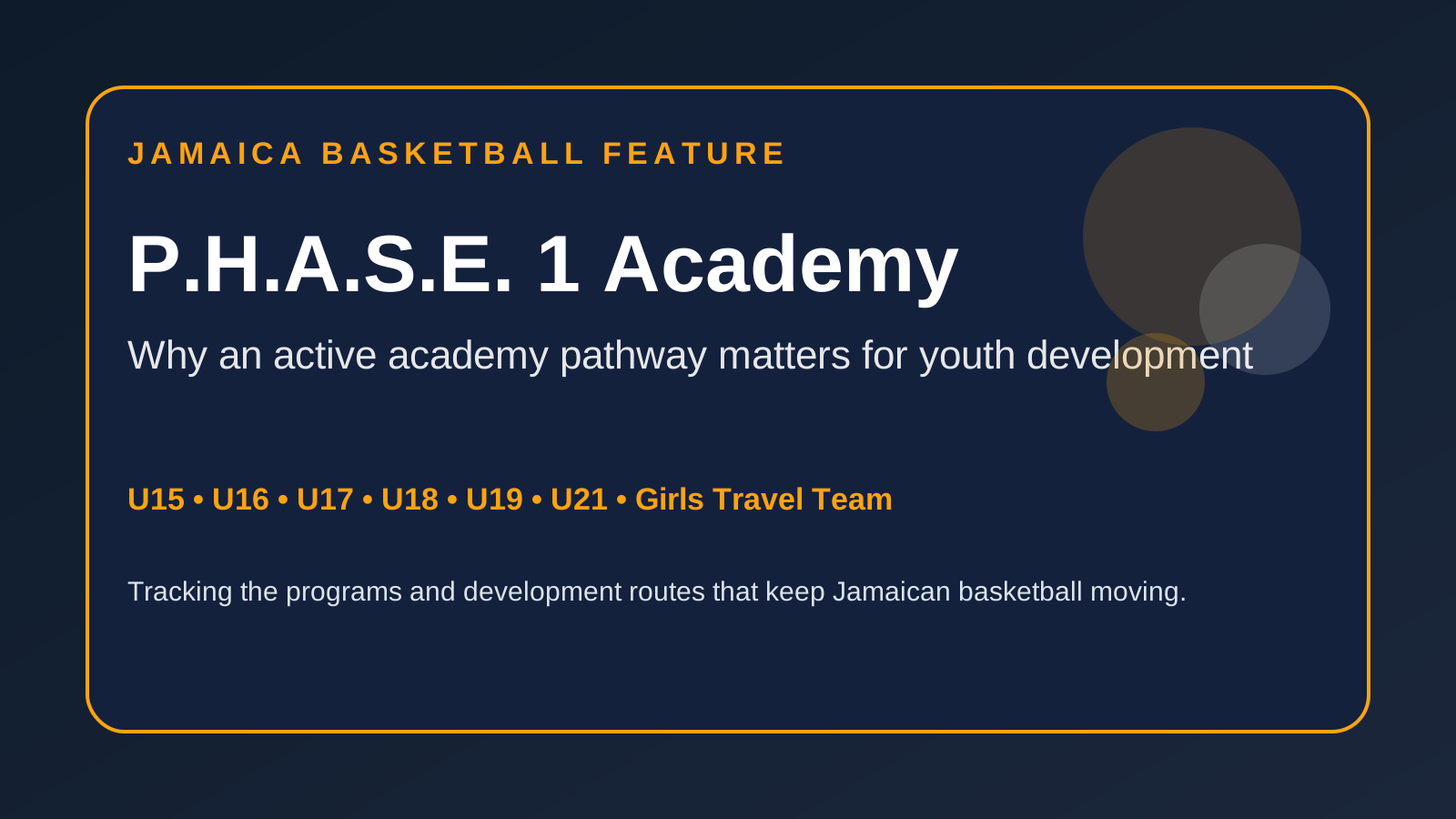
Public programme information and the current Jamaica Basketball datasheets both point to P.H.A.S.E. 1 Academy as one of the clearer examples of an active player pathway on the island. The programme has publicly listed boys travel teams stretching from under-15 through under-21, alongside a girls travel team structure. On its own, that does not guarantee elite outcomes. What it does provide is something the local game badly needs: continuity. Instead of players developing in isolated bursts, an academy structure gives them a setting where training, competition, exposure, and progression can connect over time.
Why pathways matter in Jamaica basketball
The Jamaican game has never lacked talent. What it has struggled with is continuity, visibility, and infrastructure. A player may look promising at school level, dominate in a local setting, and then still have no obvious next step that is structured, competitive, and visible enough to support long-term growth. That gap hurts players, coaches, and the broader ecosystem.
Strong basketball countries do not rely on one competition to produce the next generation. They create layers. School basketball matters. Club basketball matters. National-team programmes matter. But development pathways matter just as much because they help players bridge those spaces. They offer repetition, coaching identity, and a clearer sense of what the next level demands.
That is where an academy like P.H.A.S.E. 1 becomes significant. It gives motivated players more than occasional tournament exposure. It gives them a development environment. In a Jamaican context, that is valuable because the sport still needs more organised routes from promise to performance.
What P.H.A.S.E. 1 Academy appears to be building
Based on the publicly available programme information and the local tracking data now reflected in the site's Leagues & Programs hub, P.H.A.S.E. 1 is not operating as a single team with a catchy name. It is functioning more like a tiered programme. The under-15, under-16, under-17, under-18, under-19, and under-21 structure signals an attempt to keep players inside a developmental ladder instead of forcing them to restart every time they age out of one team.
That matters for several reasons:
- players can grow inside a clearer system
- coaches can set expectations across age groups
- families can see a longer-term pathway instead of one-off participation
- observers can track which prospects are staying active and improving
It also matters for the girls' side. Jamaican basketball needs more visible and credible development spaces for girls and young women, so any programme that publicly sustains that pathway deserves close attention.
Why visibility is almost as important as training
One of the underrated problems in Jamaica basketball is that too much development happens out of public view. If players are doing serious work but nobody can consistently see it, measure it, or talk about it, the impact is limited. Visibility is not vanity. Visibility is how the ecosystem notices progress, tracks prospects, attracts support, and creates accountability.
That is why programmes like P.H.A.S.E. 1 matter even beyond the players inside them. They help make development legible. They give parents, school coaches, club coaches, and national-team observers something to follow. They also create storylines the sport can build around. A player who is known at under-16 level, continues through under-19, and stays active into under-21 is easier to identify, support, and promote.
For a media platform like Jamaica Basketball, this is exactly the kind of layer that should not remain hidden. If the national team is the top of the pyramid and school competition is one of the most visible bases, then academy pathways are part of the structure holding the middle together.
The wider lesson for the local game
P.H.A.S.E. 1 Academy is important not because one programme can solve everything, but because it points to what the local game needs more of. Jamaica needs more environments where players train consistently, compete meaningfully, and remain visible over time. It needs more development structures that connect with the rhythms of Under-19 coverage, broader youth competition, and eventually club and national-team opportunity.
It also needs those structures to be documented. Too often, people inside the sport know what exists, but the wider basketball public does not. The result is that strong work can happen quietly without turning into a stronger national ecosystem. That is one reason the site's new league hubs matter. They create a place where active programmes can be tracked even before every story has been written.
The next step is not just praising academy work in the abstract. It is paying attention to outcomes. Which players stay with the programme and improve? Which school competitions are feeding into that pipeline? Which clubs eventually benefit? Which athletes become national-team prospects? Those are the questions that turn a development programme into a meaningful basketball story.
What this means for Jamaica basketball coverage
The local basketball conversation becomes healthier when it expands beyond results and reacts less like every story begins on game day. Development stories matter because they explain where future headlines come from. Today's under-16 or under-19 prospect is tomorrow's club contributor, scholarship hopeful, or national-team conversation piece.
That makes P.H.A.S.E. 1 Academy worth tracking closely. It sits at the intersection of development, ambition, and visibility, and those are exactly the ingredients the Jamaican game needs if it wants stronger depth over the long term.
The academy model does not replace schools. It does not replace clubs. It does not replace federation work. But it can strengthen all three by giving players a more stable path through the years when growth matters most.
FAQ
What is P.H.A.S.E. 1 Academy in Jamaica basketball?
P.H.A.S.E. 1 Academy is a basketball development programme that publicly lists multiple boys travel teams from under-15 to under-21, along with a girls travel team pathway.
Why does an academy pathway matter in Jamaica?
It gives players a more structured bridge between school competition, advanced training, exposure, and longer-term development.
Does this mean Jamaica already has a complete youth system?
No. It means there are visible pieces of a stronger system. More programmes, better documentation, and stronger links between schools, clubs, and federation structures are still needed.
Where can readers follow related coverage?
Readers can explore the site's P.H.A.S.E. 1 Academy, Under-19, and JABA hubs for connected coverage.